Grosse Pointe Farms Water Damage Restoration › Water Damage Restoration
Fixing Water Damage in Grosse Pointe Farms
Residents who find water indoors can call Grosse Pointe Farms Water Damage Restoration. A technician extracts the water, then dries floors, walls and ceilings. The median home in Grosse Pointe Farms was built in 1946, so most houses predate modern wiring and plumbing standards.
A Grosse Pointe Farms call is typically answered with dispatch in under 30 minutes. Your call puts a crew on the road right away.
We stand behind every job with a written guarantee that sends the crew back, not your money.
Our Office in Grosse Pointe Farms
The crew that answers calls from Grosse Pointe Farms starts at 17 Kercheval Ave, Grosse Pointe Farms, MI 48236 (Punch and Judy Building). The Local Headquarters sits in the Punch and Judy Building on Kercheval Avenue, in the middle of 'The Hill,' Grosse Pointe Farms' one commercial corridor, so the whole city is a short drive from the door.
Background: Grosse Pointe Farms Old Houses, Sewers and Flooding
What Every Grosse Pointe Farms Homeowner Should Know
Homes Across This City
Of 4,199 housing units in Grosse Pointe Farms, 1,509 were built in 1939 or earlier and 923 more in 1940 to 1949. That is about 58 percent built before 1950. Only about 309 units date from 1980 or later, so about 93 percent fall in the asbestos and lead-paint era. (U.S. Census Bureau ACS 2020-2024 5-year estimates)
About 97 percent of occupied homes in Grosse Pointe Farms are owner-occupied (3,944 of 4,084), and 4,052 of 4,199 units are detached single-family houses. Few apartments exist, so a loss here usually means one owner and one house. (U.S. Census Bureau ACS 2020-2024 5-year estimates)
The median value of an owner-occupied home in Grosse Pointe Farms is $442,000, so a large water or fire repair here carries a high replacement cost. (U.S. Census Bureau ACS 2020-2024 5-year, Census Reporter profile)
A village-wide sewer system was built in 1927, and a pumping station and settling tank followed in 1929 at 305 Chalfonte. The connecting pipes removed the Black Marsh Ditch, a drainage problem since the 1870s. (City of Grosse Pointe Farms, "A Walk Through Time"...)
A 1920 plat ordinance made new subdivisions build paved streets, sewers, curbs, sidewalks and water and gas mains. The village had passed its first building code in 1919. Pipes and wiring in most Farms homes date from this period. (City of Grosse Pointe Farms, "A Walk Through Time")
The Farms split from the older Village of Grosse Pointe in 1893, took its name from the ribbon farms along the shore, and became a city in 1949. Its first village boundaries ran from Fisher Road to Weir Lane and from Lake St. Clair to Mack Avenue. (City of Grosse Pointe Farms, "A Walk Through Time")
By 1913 the village had a new hall for a seven-member combined police and fire department. The combined police and fire model that the Farms still uses goes back more than a century. (City of Grosse Pointe Farms, "A Walk Through Time")
An 1893 waterworks building at 337 Lake Shore, near Moross, drew water from an intake pipe 1,200 feet into the lake. The Farms later built its own filtration plant at 29 Moross in 1930. (City of Grosse Pointe Farms, "A Walk Through Time")
In 1919 the village set up an engineering department and passed its first building code. A zoning ordinance followed in 1928 and a planning commission in 1930. (City of Grosse Pointe Farms, A Walk Through Time)
The city master plan says many single-family homes in the Farms went up in the 1920s and 1930s, and some are older. Wiring, plumbing and roofing in these houses are 85 to 100 years old unless they were replaced. (City of Grosse Pointe Farms, Master Plan (adopted December...)
The Farms has a high-density residential area of single-family homes on lots under 50 feet wide. The plan says many of these houses are legally non-conforming, so rebuilding or renovating them often needs a variance. (City of Grosse Pointe Farms, Master Plan (adopted December...)
Medium-density residential streets in the Farms hold larger homes on lots 100 to 150 feet wide. Many of these homes sit on more than one parcel. (City of Grosse Pointe Farms, Master Plan (adopted December...)
The Farms keeps its largest estates in a low-density district with lots wider than 150 feet. They cluster near the Country Club of Detroit and along Lake Shore Drive, and many have large accessory buildings. (City of Grosse Pointe Farms, Master Plan (adopted December...)
The Farms has one group of attached condominiums, between Willow Lane and Carrington Place. It also has eight older two-family houses, on Muir Road, Hillcrest Road, Moross Road and Lakeview Avenue. (City of Grosse Pointe Farms, Master Plan (adopted December...)
Residents named neighborhood character as the feature that sets the Farms apart. The densest tree cover runs along Touraine Road and Cloverly Road, while Chalfonte Avenue and the golf course have little cover. (City of Grosse Pointe Farms, Master Plan (adopted December...)
Water supply
Farms drinking water comes from a filtration plant built in 1930 at 29 Moross. The building has a Neo-Georgian front that hides its working purpose. (City of Grosse Pointe Farms, A Walk Through Time)
The master plan says the Farms filtration plant draws its raw water from Lake St. Clair. (City of Grosse Pointe Farms, Master Plan (adopted December...)
Utility Billing watches meter readings for unusual use and sends water and sewer staff to check customer problems. A sudden jump in use can signal a hidden leak. (City of Grosse Pointe Farms, Utility Billing page)
Road Access in Grosse Pointe Farms
Mack, Lake Shore and Moross are county primary roads in the Farms. Kercheval, Kerby, Fisher and McMillan are major roads under city control. (City of Grosse Pointe Farms, Master Plan (adopted December...)
Moross and McMillan/Moran are wide roads that carry higher volumes at higher speeds between Mack and Lake Shore. (City of Grosse Pointe Farms, Master Plan (adopted December...)
The plan lists Mack and Moross, Moross and Chalfonte, and Moross and Kercheval as conflict points for cars and pedestrians. Expect slow turns at these corners. (City of Grosse Pointe Farms, Master Plan (adopted December...)
Many Farms houses have little garage space and narrow driveways, so cars park on the street. The plan says this blocks trash and snow removal and can limit city services. (City of Grosse Pointe Farms, Master Plan (adopted December...)
Truck traffic in the Farms centers on the Mack and Kercheval business districts, and The Hill puts the most truck pressure on local streets. Alleys and service drives sit behind the stores. (City of Grosse Pointe Farms, Master Plan (adopted December...)
I-94 lies about a mile north of the Farms, and the plan names Jefferson Avenue to the southeast and Mack Avenue to the northwest as major access roads. (City of Grosse Pointe Farms, Master Plan (adopted December...)
The Farms has 2.75 square miles of land and a low ridge through the middle. It also holds the bend in the shoreline east of the War Memorial. Streets form a grid in some parts and curve in others. Its downtown on Kercheval Avenue is called "The Hill". (Wikipedia, Grosse Pointe Farms, Michigan)
Henry Ford Medical Center - Cottage sits at 159 Kercheval on The Hill. Ascension St. John Hospital is at 22101 Moross Road, on the Farms' border with Detroit. (City of Grosse Pointe Farms, Hospitals page)
Lake St. Clair forms more than two miles of the Farms eastern edge. The lake is the main water entry point at Pier Park and the Crescent Sail Yacht Club. (City of Grosse Pointe Farms, Master Plan (adopted December...)
Local Rules and Permits
The Building Department issues permits, reviews plans and inspects work for homes in the Farms. Permits can be requested online. The city lists a Public Service Director as the contact at (313) 885-4285. (City of Grosse Pointe Farms, Building Department page)
Inspections for Farms permits are booked through the BS&A online portal or by phone. The city asks for the job address, permit number and type of inspection. (City of Grosse Pointe Farms, Inspection Scheduling)
The Farms lists the 2015 Michigan Residential Code and the 2021 Michigan Plumbing Code (effective March 12, 2024) among its adopted codes. A repair job on a Farms home follows these editions. The city says the residential code is under review. (City of Grosse Pointe Farms, Commercial and Residential Codes)
Chapter 8-08 of the Farms code covers stormwater discharge control, next to chapter 8-06 on wastewater discharge control. Both apply to what a property may send to the sewers. (City of Grosse Pointe Farms, Code of Ordinances table of...)
Local Contacts and Programs
In the sewer separation project the city agreed a 55-year deal with the Country Club of Detroit, with easements that last forever. The deal includes an upgraded water main to the club pump station. (C&G Newspapers, Apr. 2, 2025)
The Farms loose-leaf program runs from October 12 to December 11, 2026. The city tells residents not to park on the street on rubbish day, because a parked car blocks the leaf pile and can pose a fire risk to the car. (City of Grosse Pointe Farms, Loose-Leaf Collection Program)
The Farms is putting a new storm sewer through Tonnancour Place, Kercheval Avenue and the Country Club of Detroit. The city posts monthly notices, and a public meeting took place at Pier Park on August 19, 2026. (City of Grosse Pointe Farms, Sewer Enhancement Project Update)
The Farms Public Safety Department answers on (313) 885-2100. Its dispatch center takes enhanced 911 calls, and the department runs advanced life support ambulance service. (City of Grosse Pointe Farms, Public Safety page)
The Water & Sewer Department phone is (313) 885-6600. The same office runs the Kerby Road pumping station and three storm sewer overflows. (City of Grosse Pointe Farms, Water & Sewer page)
The Public Service Department, which oversees public works, snow removal and permits, lists (313) 885-4285 as its phone. (City of Grosse Pointe Farms, Public Service page)
The Farms home page carries a sign-up link for Nixle emergency alerts, and the city also runs an e-blast list. (City of Grosse Pointe Farms, home page)
Around Grosse Pointe Farms: Neighborhoods and Areas
- The Hill: The Farms downtown on Kercheval Avenue mixes historic buildings with newer storefronts. (Wikipedia, Grosse Pointe Farms, Michigan)
- Inland (Ridge) District: The part of the Farms away from the lake that still has a combined storm and sanitary sewer; most 2011 backups were here. (Patch Grosse Pointe, June 7, 2011)
- Lakeside (Lake) District: The shoreline part of the Farms, separated into storm and sanitary sewers in 1999-2000. (C&G Newspapers, Sept. 21, 2022)
- Pier Park: Lakefront park with the Community Building that houses the Parks and Recreation Office. (City of Grosse Pointe Farms, Parks & Recreation)
- Tonnacour Place: Street where the new stormwater outfall to Lake St. Clair meets Lake Shore Road. (C&G Newspapers, Apr. 2, 2025)
- Medium-density residential streets: Homes sit on lots 100 to 150 feet wide, and many homes cover several parcels. (City of Grosse Pointe Farms, Master Plan (adopted December 11, 2023))
- Country Club of Detroit and Lake Shore Drive estates: The largest estate lots, over 150 feet wide, cluster here. (City of Grosse Pointe Farms, Master Plan (adopted December 11, 2023))
- Touraine Road and Cloverly Road: These streets hold the densest tree cover in the city. (City of Grosse Pointe Farms, Master Plan (adopted December 11, 2023))
- Willow Lane to Carrington Place: The city's one area of attached condominiums sits here. (City of Grosse Pointe Farms, Master Plan (adopted December 11, 2023))
- Mack Avenue business district: The commercial strip runs along Mack and holds mostly one-story buildings. (City of Grosse Pointe Farms, Master Plan (adopted December 11, 2023))
ZIP codes in Grosse Pointe Farms: 48230, 48236.
Frequent Triggers for Water Loss
- Ice maker and fridge lines that crack
- Sewer water returning through basement drains
- Pipe breaks after cold snaps
- Water heater tanks that split at the seam
- Sump pump failure when storms hit hard
- Roof leaks that start with worn flashing or ice
- Dishwasher, washer, or tub overflow
Symptoms of a Wet Structure
- Damp carpet along an outside wall
- Persistent musty odor
- Door frames and baseboards that swell
- A ceiling stain with a ring around it
- Flaking paint and bubbled wallpaper
- A damp feel in the air, even with the heat off
How a Water Job Runs
| Step | The work |
|---|---|
| Inspect | On arrival we inspect for the cause and the extent. We ask what happened and when. Then we check surfaces with meters, since damp materials often look normal. |
| Quarantine the wet area | We label the water by contamination type. Wet rooms get plastic barriers. Clean areas stay protected from dust, germs, and humidity that could spread. |
| Water pickup | We start pumping at once when water is deep. Wet vacuums follow for thin layers. Wet padding and swollen trim are cut out so they cannot trap water. |
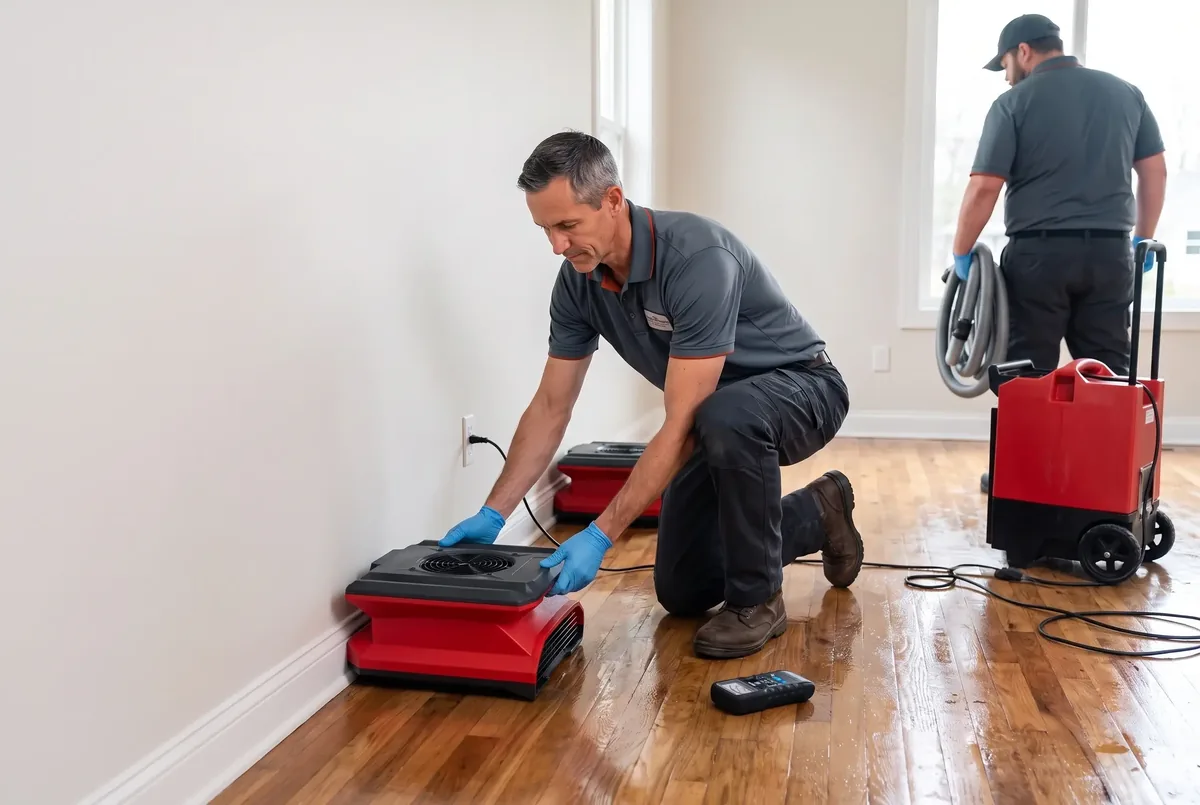
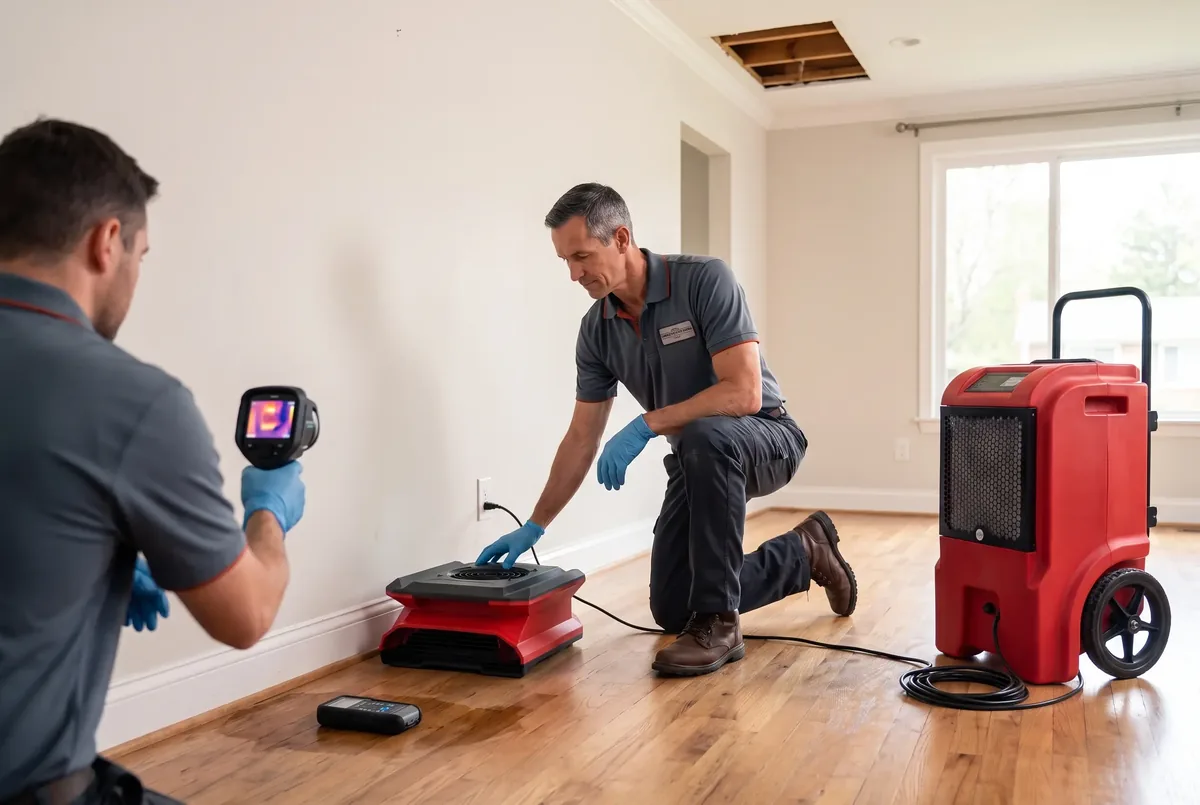
| Drying cycle | Equipment runs all day in the wet zone. We visit, record numbers, and shift machines. The cycle stops when each material meets the dry goal we set at the start. |
| Cleaning pass | We clean the dry surfaces and treat them. Items beyond saving are removed with care. A filtered air machine runs while we clean. |
| Reconstruction and reports | We write a repair plan for what was removed. We also compile a report with photos, readings, and daily notes. You keep a copy for your own use. |
Professional Gear List
- Powerful extractors, truck-based or hand-carried
- Deep-water submersible pumps
- Fans that move air across wet surfaces
- Refrigerant dehumidifiers with LGR design
- Meters that read water in building materials
- Thermal cameras for inspection
- Hygrometers for air checks
- Air scrubbers with filters of HEPA grade
When the Crew Arrives
Think of the process in three parts. First, the crew assesses and stops the spread. Second, they remove water and dry the structure. Third, they clean, review the results with you, and plan repairs. At each part, you get a plain explanation and a chance to ask anything. The crew treats your home with care.
Questions, Answered with Care
What affects how quickly the crew gets there?
Distance, traffic, weather, and the number of calls at the time. We tell you our estimate on the phone. If conditions change, we call you with a new one. Share any safety concerns, such as an active leak.
Is the home safe to occupy during the job?
The crew decides after an inspection. Clean-water losses are often fine for staying. Sewage or other contaminated water requires you to leave the affected spaces. Equipment cords and hoses also need care around kids, so ask the crew where to walk.
Can you tell me exactly when it will be dry?
Not at the start. Exact timing is unknown until the crew sees how deep the water went and how materials respond. Readings at each visit give a clearer picture, and the crew shares them with you.
Will the paperwork support my claim?
The file records what we found and did, with photos and readings, in plain order. Adjusters can use it to review the loss. We cannot promise any result, since the insurer reviews the claim under your policy.
Is there a useful task I can finish ahead of the crew?
Yes. Stop the leak where it starts if you can. Remove loose items from wet floors. Keep electric fans away from standing water. Take photos of damage and make a list of affected belongings for later.
Can you summarize older homes in Grosse Pointe Farms?
The median home in Grosse Pointe Farms was built in 1946, so most houses predate modern wiring and plumbing standards.
Can you summarize repair permits in Grosse Pointe Farms?
The Building Department issues permits, reviews plans and inspects work for homes in the Farms. Permits can be requested online. The city lists a Public Service Director as the contact at (313) 885-4285.
Can you summarize service coverage in Grosse Pointe Farms?
The Farms has 2.75 square miles of land and a low ridge through the middle. It also holds the bend in the shoreline east of the War Memorial. Streets form a grid in some parts and curve in others. Its downtown on Kercheval Avenue is called "The Hill".
Found water inside? We can help.
Speak with the crew at (313) 509-3836.
A Grosse Pointe Farms call is typically answered with dispatch in under 30 minutes. Your call puts a crew on the road right away.
A free on-site estimate comes with every call.
We stand behind every job with a written guarantee that sends the crew back, not your money.